

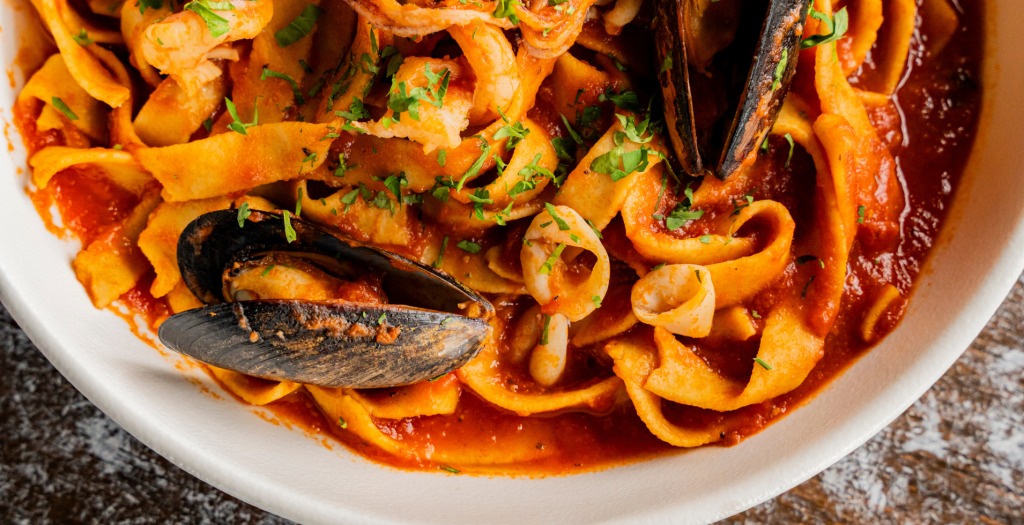
A guide to identifying authentic fresh pasta at an Italian restaurant in Cancun and Playa del Carmen
If you’re searching for fresh pasta in Cancun, an authentic Italian restaurant, or where to eat handmade pasta in Playa del Carmen, there’s one reality few people mention:
Not everything labeled as fresh pasta actually is.
Today, many restaurants use the term as an attractive label. But the difference between truly handmade pasta and industrial or pre-made versions becomes clear to anyone who knows what to look for.
The truth is not in what is said. It’s in how the pasta behaves on the table—its texture, its cooking, and how it interacts with the sauce.
At Nicoletta, fresh pasta is not a decorative concept. It is a technical execution that reveals itself in every detail.
What Fresh Pasta Really Means
Beyond the name
Artisan fresh pasta is made from a simple mixture of flour and eggs (or water, depending on the region), worked by hand or with traditional methods.
Unlike dried pasta, it does not go through a long dehydration process.
This changes everything:
- Greater elasticity
- Softer texture
- Superior ability to absorb sauce
When someone searches for an Italian restaurant with fresh pasta, this is the difference they are actually looking for.
Texture: The First Sign of Authenticity
How real fresh pasta feels
Texture is one of the clearest indicators.
Authentic fresh pasta should feel:
Soft, yet structured.
Flexible, yet resistant.
It should never feel rigid or brittle.
When you bite into it, it should yield naturally—without excessive effort.
If the pasta feels too firm or dry, it is likely not fresh or not properly executed.
Elasticity: The Detail Few Notice
How pasta responds to movement
Elasticity is a defining trait of fresh pasta.
When you twirl it with a fork, it should adapt effortlessly—never breaking or fragmenting.
This quality comes from proper hydration and the development of gluten during the kneading process.
In authentic Italian pasta, elasticity is not accidental. It is the result of technique.
Sauce Absorption
Where the difference truly appears
One of the greatest advantages of fresh pasta is how it integrates with sauce.
It does not simply sit beneath it.
It absorbs and binds with it.
This creates a more cohesive and balanced bite.
By contrast, industrial pasta often leaves the sauce sitting on the surface, without true integration.
In an Italian restaurant in Cancun, this detail defines the entire experience.
Cooking Time
A clue that never fails
Fresh pasta cooks significantly faster.
In many cases, just a few minutes are enough to reach the ideal point.
If pasta takes too long to cook, it is likely not fresh.
Cooking must also be precise—neither undercooked nor overdone.
The correct timing is what preserves both texture and elasticity.
Nicoletta and Fresh Pasta
Where technique becomes evident
At Nicoletta, fresh pasta is crafted with respect for Italian tradition.
It is not about replicating an idea—it is about executing each stage correctly:
- Precisely hydrated dough
- Controlled kneading
- Proper shaping for each preparation
- Exact cooking times
The result does not need explanation.
It is felt.
More Than Pasta: A Complete Experience
When technique integrates with atmosphere
In an elegant Italian restaurant in Cancun or Playa del Carmen, pasta is only part of the experience.
Atmosphere, service, and rhythm accompany the cuisine.
Everything works together to create coherence.
That is why the quality of pasta is not judged in isolation—but as part of a complete experience.
Knowing How to Recognize It Changes Everything
The difference between real fresh pasta and something that only claims to be is not in the words.
It is in the experience.
In the texture.
In the elasticity.
In the way it integrates with the sauce.
If you are searching for fresh pasta in Cancun or an Italian restaurant in Playa del Carmen where technique is evident in every detail, reserve your table at Nicoletta.
Follow us on social media and discover why, in Italian cuisine, authenticity is not announced—it is demonstrated.