
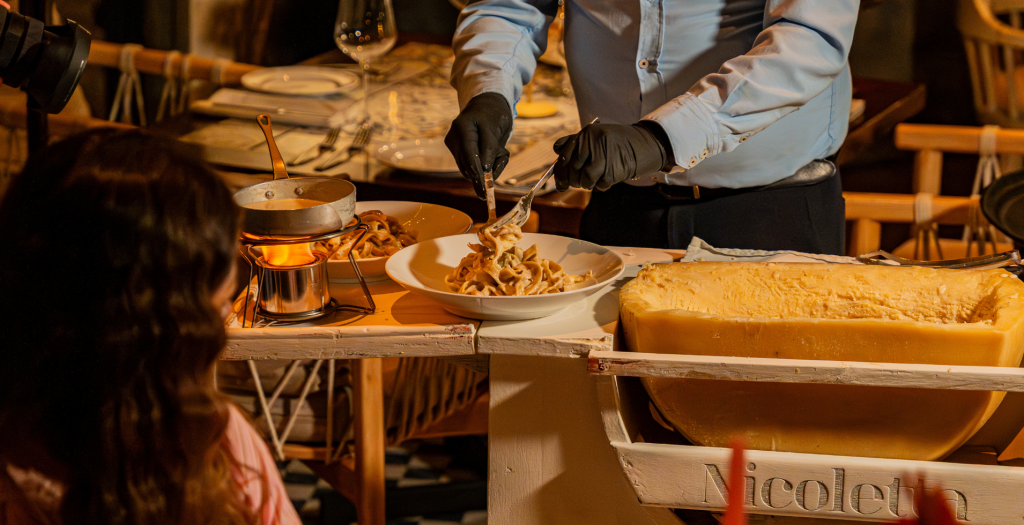
If you’ve ever wondered why pasta made at home—even with good ingredients—never quite matches what you experience at an Italian restaurant in Cancun or during a refined dinner in Playa del Carmen, the answer is often unexpected: it’s not the recipe.
For years, the conversation around Italian cuisine has focused on ingredients—quality wheat, fresh sauces, carefully sourced cheese. While all of that matters, it doesn’t define the real difference. The gap between a decent pasta and a memorable one lies in technique.
In Italian cooking, especially in spaces where precision is essential like Nicoletta, pasta is not about assembling ingredients. It’s about timing, texture, and a series of nearly invisible decisions that, when executed correctly, elevate simplicity into something exceptional.
Beyond the recipe: the Italian culture of precision
Simplicity as a discipline
In authentic Italian cuisine, simplicity is never synonymous with ease. In fact, the more minimal a preparation appears, the more demanding it becomes.
A pasta with few elements leaves no room for error. Texture, temperature, and integration are fully exposed.
That’s why in an elegant Italian restaurant in Cancun, execution is what sustains the experience. The recipe is only the starting point.
Product vs execution: the most common misconception
It’s easy to assume that using high-quality ingredients guarantees a similar result. In reality, without technique, even the best product falls short.
At Nicoletta, ingredient selection follows strict standards, but what truly defines each preparation is how those elements are handled—how they are combined, when they are introduced, and at what temperature they are managed.
The difference lives in what happens between the steps.
The best-kept secret: emulsification
What emulsification is—and why it changes everything
One of the most overlooked concepts outside professional kitchens is emulsification.
In simple terms, it is the ability to combine elements that don’t naturally blend—such as fat and water—into a smooth, cohesive texture. In pasta, this means creating a sauce that clings seamlessly, resulting in a silky, unified finish.
It’s not about coating the pasta; it’s about integrating it.
The role of pasta water
The water used to cook pasta is not waste—it’s a tool.
Rich in starch, it helps adjust the texture of the sauce and facilitates emulsification. When added at the right moment, it transforms separate components into a cohesive experience.
This seemingly minor detail is one of the reasons why pasta in a restaurant in Cancun by the lagoon like Nicoletta feels different—more fluid, more refined, more precise.
Al dente: more than a texture, a decision
The exact point that defines the experience
The term al dente is often understood as “slightly firm,” but it goes far beyond that.
Cooking pasta to the correct point ensures it maintains structure, interacts properly with the sauce, and delivers balance in every bite.
A matter of seconds can completely alter the result.
The mistake of linear timing
At home, it’s common to follow the cooking time on the package rigidly. In professional kitchens, that timing is only a reference.
Variables such as water volume, heat intensity, pasta type, and the moment it is combined with the sauce all affect the final outcome.
At Nicoletta, this process is constantly adjusted. It’s not about following a clock—it’s about reading the pasta.
Butter vs olive oil: a choice that defines character
Not preference, but intention
One of the most common debates is whether to use butter or olive oil. In true Italian cooking, this choice is never arbitrary.
Butter creates a more enveloping, rounded texture. Olive oil introduces a lighter, more direct profile.
Choosing one over the other changes the structure of the preparation—not just its flavor.
How it affects emulsification
Fat plays a crucial role in achieving proper emulsification—but not all fats behave the same way.
Butter, when combined with pasta water, creates a more stable integration. Olive oil requires greater control to achieve a similar effect.
These subtle decisions are what define the experience in an Italian restaurant in Playa del Carmen where technique is at the core.
Timing: the true language of Italian cooking
Every second matters
If there is one element that defines Italian cuisine, it is timing.
It’s not enough to have everything prepared—you need to know exactly when each step happens. When to remove the pasta from the water, when to combine it with the sauce, when to adjust texture, when to serve.
The window for perfection is brief. And that’s where everything happens.
The mistake of separating processes
At home, it’s common to prepare the sauce separately and then combine it with the pasta at the end. This approach breaks the logic of Italian cooking.
Integration must happen together, in real time. The pasta finishes cooking in the sauce, absorbing flavor, adjusting texture, completing the process.
At Nicoletta, this moment is essential. It’s not just another step—it’s where everything comes together.
The Nicoletta experience: when technique becomes invisible
Precision without performance
In an elegant restaurant in Cancun, technique is not displayed—it is felt.
There are no unnecessary explanations or exaggerated gestures. Execution happens naturally, allowing the experience to unfold without interruption.
This is what separates a kitchen that aims to impress from one that aims to remain.
Rhythm, service, and context
Pasta does not arrive in isolation. It exists within a broader context: the rhythm of service, the temperature of the environment, the sequence of the experience.
At Nicoletta, everything is aligned so each element arrives at the exact right moment—not before, not after.
This is how technique, though invisible, becomes unmistakable.
Technique as the true luxury
The reason your pasta never tastes like it does at an Italian restaurant isn’t about what’s missing in your kitchen—it’s about what happens between each step.
Emulsification, precise doneness, the choice of fat, timing—these elements build an experience that goes far beyond a recipe.
At Nicoletta, this technique translates into an elegant, precise, and cohesive experience, where every detail serves a purpose and where Italian cuisine finds its place in the Caribbean.
If you’re looking for an elegant Italian restaurant in Cancun or a distinctive dinner in Playa del Carmen, the difference lies in those details you may not always see—but will always feel.
Reserve your place at Nicoletta and discover the experience.
Follow us on social media and become part of a cuisine where technique becomes art.